
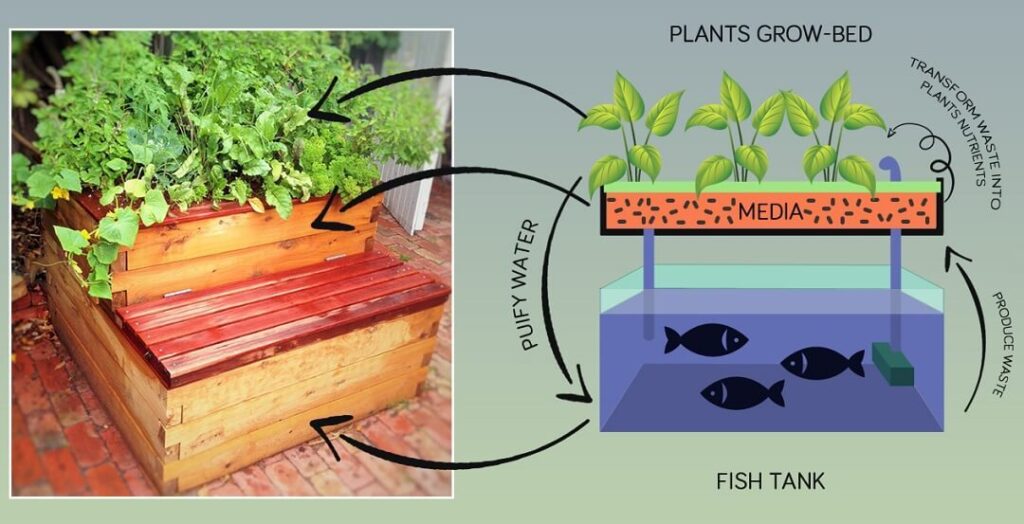
The growing medium you choose for your aquaponics system plays a critical role in plant support, root health, bacterial colonisation, and overall system performance — getting it right from the start makes everything easier.
Why Growing Media Matters in Aquaponics
Unlike hydroponics, where nutrient solution is the primary focus, aquaponics growing media serve multiple critical functions simultaneously. They anchor plant roots, allow water and oxygen to flow through, and — most importantly — provide a vast surface area for the beneficial bacteria that drive the nitrogen cycle.
The ideal aquaponics growing medium is:
- pH neutral — Won’t alter the water chemistry of your system
- Porous — Allows adequate water drainage and air circulation
- Durable — Maintains structure and doesn’t break down over time
- Non-toxic — Safe for fish, plants, and beneficial bacteria
- Appropriately sized — Usually 10–25mm particle size for good flow and root support
The Most Popular Aquaponics Growing Media
Expanded Clay Pebbles (Hydroton/LECA)
Expanded clay pebbles are the most widely used aquaponics growing medium worldwide. Made by heating clay to high temperatures until it expands and becomes porous, these lightweight balls offer excellent drainage, strong bacterial colonisation surface area, and pH neutrality.
Pros: Reusable, pH stable, lightweight, widely available
Cons: More expensive upfront; requires thorough rinsing before use
Gravel
River gravel or pea gravel is a cost-effective and widely available option. It provides excellent support for plants and good bacterial habitat. The main consideration is ensuring it’s pH neutral — limestone-based gravels can raise pH over time, which is problematic for system stability.
Pros: Cheap, heavy (good for tall plants), durable
Cons: Heavy (harder to handle and move), some types affect pH; check with vinegar test before use
Volcanic Rock (Scoria/Pumice)
Volcanic rock — particularly scoria — is an excellent aquaponics medium. It’s porous, pH neutral, lightweight relative to gravel, and provides outstanding surface area for beneficial bacteria. It’s commonly used in Australia where it’s locally available and affordable.
Pros: Excellent porosity, pH neutral, good bacterial surface area, locally available in many regions
Cons: Sharp edges can be rough on hands; quality varies by source
Perlite and Vermiculite
While common in potting mixes, pure perlite and vermiculite are generally not recommended as standalone aquaponics media. They’re too light and tend to float, clog drains, and break down over time. They can be useful in small amounts mixed with other media for seedling propagation.
Coco Coir
Coco coir is occasionally used in aquaponics, particularly in wicking or NFT (nutrient film technique) setups. It retains moisture well and is excellent for seedlings. However, it breaks down over time and can cause drainage issues in flood-and-drain media beds.
How to Choose the Right Medium for Your System
Your choice of growing media should be guided by:
- System type — Media beds require deeper, stable media; NFT and DWC need little or no media
- Budget — Gravel and volcanic rock are cost-effective; clay pebbles offer premium performance
- Plant types — Heavy fruiting crops (tomatoes, capsicums) benefit from denser, heavier media for support
- Local availability — Source locally where possible to reduce cost and environmental impact
- pH impact — Always test media with vinegar before use; fizzing indicates calcium carbonate content that will raise pH
Preparing Your Growing Media
All new growing media should be thoroughly rinsed before use to remove dust, fine particles, and potential contaminants. For media beds, aim for a depth of 25–30 cm to support root development and provide adequate bacterial habitat. Avoid media finer than 5mm as this can impede drainage and cause anaerobic zones.
Frequently Asked Questions
Can I use sand as a growing medium in aquaponics?
Sand is generally not recommended. Its fine particle size creates poor drainage, compacts easily, and can form anaerobic (oxygen-free) zones that produce toxic hydrogen sulphide. If you do use sand, coarse sand in shallow beds with very regular flooding and draining may work, but it presents ongoing management challenges.
How often do I need to replace growing media in aquaponics?
Quality media like expanded clay pebbles and volcanic rock can last indefinitely with proper care. Occasionally, media may need to be removed and cleaned if it becomes excessively clogged with solids. In practice, well-managed systems rarely need media replacement for many years.
Do I need to sterilise growing media between crops?
In aquaponics, the beneficial bacterial colony in your media is an asset — you generally want to preserve it, not sterilise it. Between crops, simply remove plant roots, rinse the media with system water (not tap water, which may contain chlorine), and replant. Full sterilisation is only necessary if treating a disease outbreak.
What’s the vinegar test for growing media?
Place a sample of your growing medium in a small amount of white vinegar. If it fizzes or bubbles, the medium contains calcium carbonate (limestone). This will gradually dissolve into your water and raise pH over time, making it unsuitable for aquaponics without treatment. Choose a non-reactive medium instead.
How much growing media do I need for my aquaponics system?
For media bed systems, a depth of 25–30 cm is recommended. The volume of media required depends on the size of your grow beds. A common ratio is roughly 1:1 fish tank volume to grow bed volume (by water volume), so a 500L fish tank would typically pair with 500L of grow bed space.
Ready to build your aquaponics system the right way from the ground up? Get the complete build guide here and have a fully functional system ready in just 2 hours.