
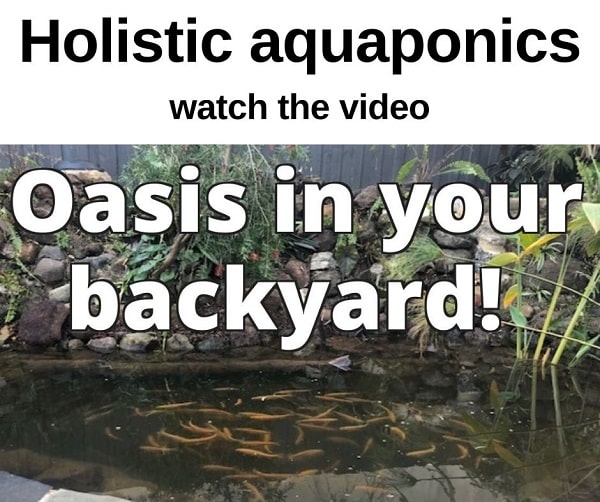
Holistic aquaponics transforms a productive food system into a complete backyard ecosystem — combining a swimming pond, a fish habitat, a food garden, and a stunning water feature into one beautifully integrated design.
Most people think of aquaponics as fish tanks and grow beds. But taken to its full potential, aquaponics can replace your backyard pool with a natural swimming pond, create a wildlife habitat, and grow an abundance of food — all from the same water. Here’s how to design a truly holistic aquaponics system.
What Is Holistic Aquaponics?
Holistic aquaponics integrates the productive aquaponics ecosystem with broader landscape and lifestyle elements. Rather than keeping fish tanks separate from your garden and living areas, holistic design weaves them together into a single, self-sustaining system that serves multiple purposes simultaneously.
The Core Holistic Aquaponics Elements
- Natural swimming pond: A plant-filtered swim zone using aquaponics principles — no chlorine, no chemicals.
- Fish habitat zone: A deeper section for fish production, protected and thermally stable.
- Vegetable grow zone: Raft beds, media beds, or both, positioned around the pond perimeter.
- Aesthetic landscape integration: Rock edging, timber structures, plantings, and paths that make the system a centrepiece of your property.
- Closed water loop: One pumped circuit connecting all zones — minimal water waste, maximum efficiency.
How Does a Natural Swimming Pond Work With Aquaponics?
A natural swimming pond uses biological filtration instead of chemical treatment. The principle is identical to aquaponics: plants filter the water, beneficial bacteria maintain the nitrogen cycle, and balanced biology keeps the water safe for swimming.
Zone Design
Divide your pond into two linked zones:
- Swim zone: Deeper water (1.5–2 m), clear of plant growth, suitable for swimming. Water is continuously circulated to the regeneration zone.
- Regeneration zone: Shallower margins (30–60 cm) densely planted with aquatic plants and marginals. These plants consume nutrients, filter particles, and oxygenate the water before it returns to the swim zone.
Your aquaponics grow beds function as an extension of the regeneration zone — removing dissolved fish waste from the water before it re-enters the swim zone.
Water Quality and Safety
Well-designed natural swimming ponds achieve water quality comparable to chlorinated pools without any chemical treatment. Key management principles:
- Maintain a minimum 50% regeneration-to-swim zone ratio
- Ensure strong water circulation (full volume turnover every 2–4 hours)
- Maintain healthy aquatic plant coverage in the regeneration zone
- Monitor pH (target 6.8–7.5), ammonia (<0.5 ppm), and clarity regularly
How to Design a Holistic Aquaponics System
Step 1: Plan Your Water Volume and Fish Load
The fish zone determines how much food your system can grow. Start with your desired harvest:
- 1 kg of fish per week requires roughly 500–700 litres of fish zone volume
- Add 10–15% more volume for buffer and water quality stability
- Size your grow beds or raft area at 1:2 ratio to fish tank volume
Step 2: Integrate the Swim Zone
Your swim pond adds water volume that stabilises the entire system — more water means slower temperature swings, more dilution capacity, and greater biological resilience. Size the swim zone to your lifestyle: a family swimming pond typically needs a minimum of 30–40 m² surface area and 50,000+ litres.
Step 3: Design the Water Circuit
All zones connect in a single loop:
- Fish zone water (nutrient-rich) pumps to grow beds/raft systems.
- Filtered water from grow beds flows to the regeneration zone plantings.
- Cleaned, oxygenated water returns to the swim zone and fish zone.
One pump, one filter system, one biological community — elegant and efficient.
Step 4: Choose Materials for Aesthetic Integration
Holistic aquaponics looks intentional and beautiful, not industrial. Material choices matter:
- Pond liner: EPDM rubber liner for flexibility; concrete render for permanence
- Grow bed edging: Timber sleepers, local stone, or rendered concrete blends naturally into garden design
- Paths: Gravel, timber decking, or stepping stones between zones invite interaction with the system
- Planting: Natives and edibles around the perimeter blur the line between food garden and ornamental landscape
What Fish Work Best in a Holistic Aquaponics System?
Choose fish suited to your climate and compatible with a natural, less intensively managed environment:
- Silver perch: Hardy, fast-growing, excellent for Australian conditions — tolerates a wide temperature range
- Murray cod: Native to Australia, impressive size, moderate temperature tolerance
- Goldfish or koi: For ornamental-priority systems — beautiful, hardy, but not edible for most people
- Barramundi: Outstanding eating quality, fast growth — best in tropical and subtropical climates
What Can You Grow in a Holistic Aquaponics System?
With larger water volumes and integrated landscape, holistic systems support a wider range of produce:
- Leafy greens and herbs (raft beds or media beds)
- Fruiting vegetables (tomatoes, zucchini, capsicum — in media beds with adequate fish density)
- Fruit trees (in beds adjacent to the pond, irrigated by overflow)
- Aquatic edibles (watercress, water chestnuts, lotus root)
- Native edible plants (lemon myrtle, native ginger) integrated as landscape planting
Frequently Asked Questions
Is a natural swimming pond safe for children?
Yes, with proper design and management. Natural ponds have been used in Europe for decades with an excellent safety record. Shallow entry zones, clear sight lines, appropriate fencing, and regular water quality testing are all essential for family safety.
How much does a holistic aquaponics system cost to build?
Costs vary enormously depending on scale and finishes. A modest holistic backyard system (20,000–50,000 L total volume) typically costs $10,000–$40,000 to build, including excavation, liner, plumbing, grow beds, and landscaping. A professionally designed and built system with pool-quality finishes can exceed $100,000.
Can I retrofit an existing swimming pool into a holistic aquaponics system?
Yes — this is one of the most popular holistic aquaponics conversions. An existing pool shell becomes the fish/swim zone; the surrounds are rebuilt as grow beds and regeneration plantings. The main modification is installing overflow plumbing and redirecting the existing pump circuit.
How much maintenance does a holistic aquaponics system need?
Once established (typically 3–6 months to biological maturity), a well-designed holistic system is largely self-maintaining. Expect 2–4 hours per week: feeding fish, harvesting produce, checking water quality, and managing plant growth. Far less than a conventional swimming pool.
Ready to design and build your own aquaponics system — from a simple backyard setup to a full holistic design? Our complete aquaponics training shows you exactly how to plan, build, and run a system that suits your space and goals.
Hi Jonathon, great idea.
I wonder if ducks fit into aquaaponics?
Hi Peter! Well we can use ducks but we must be careful as they are warm blood animals. They could bring listeria and E.coli bacteria. Hence I prefer working with fish. Ducks would be great for a tree aquaponics system though.
I’m so excited to see this system! I live near Las Vegas and am hoping to do aquaponics, and would love to set up something like this in a greenhouse. Looking forward to more great videos.
Thanks Cordelia, yes in a greenhouse the productivity will be even much better! What a beautiful passion!
What type of fish would you grow?
Hi,
I love the idea of aquaponics. I’m wondering if you could combine it with a ‘natural swimming pool’ so it becomes a three tier system; the pool to swim in, the fish pond, and then the grow beds to filter the water before it goes back into the natural swimming pool.
Hi Andy! Yes 100%. Your project would be like mine but at a very large scale. Totally doable 🙂
Hi.
I find this really interesting. I have a 25,000 litre billabong in my backyard in Melbourne. I use it to catch all the rain water from the roof. I have 12 silver perch currently but of course it could hold a lot more fish.
Is it possible to use this size water storage for aquaponics or is it too big?
Hi Graham, 25 000 litres is very large! Yes you can, however you either need a bio-reactor either a very large grow-bed (ideally 10 m3). Another option would be to work on DWC or NFT but doesn’t look really cool in my view. Also, is your billabong water clear? if not you may have plenty of clay on the bottom. it would require a lot of gypsum to clear and wouldn’t be ideal for aquaponics.
Hi Jonathan
really nice and wonderful experience, but unfortunately, it is applied at home. I have a really difficult temperature problem for us because we are in Iraq up to 55 degrees in the summer
Hello Jonathon, I Absolutely love your passion and willingness to share your knowledge for a greater good in this area of Aquaponics and this new holistic approach is a brilliant idea. Thank you my Friend.
Thanks for the nice feedback Martin, all the best with your aquaponics project 🙂