
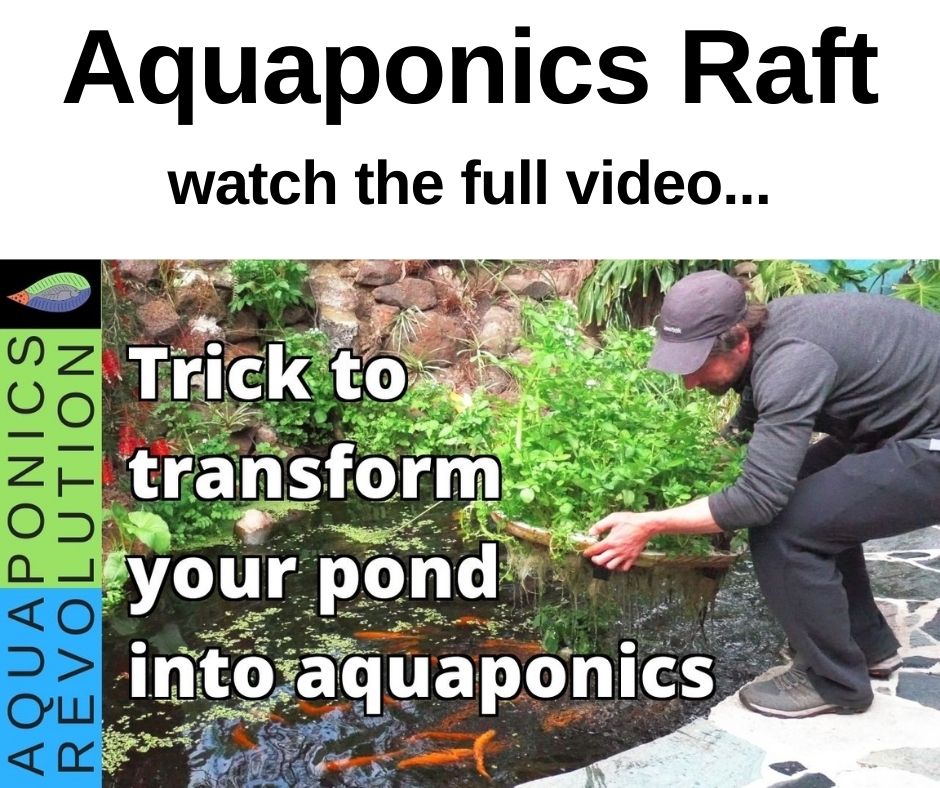
A floating raft aquaponics system is one of the most productive, low-maintenance methods to grow vegetables — and if you already have a fish pond, you can start one today with almost no infrastructure.
Aquaponics raft systems — also called Deep Water Culture (DWC) systems — suspend plant roots directly in nutrient-rich fish pond water. Plants grow faster than in soil, fish benefit from cleaner water, and you need no pumps, no timers, and no complicated plumbing. This guide covers everything you need to design, build, and run a productive aquaponics raft system.
What Is an Aquaponics Raft System?
An aquaponics raft is a buoyant platform — typically made from foam, polystyrene, or floating foam board — that sits on the surface of a fish pond or dedicated grow channel. Plants are placed in net pots inserted into holes cut into the raft, with roots hanging directly into the water below.
How Does a Raft System Differ from Other Aquaponics Types?
- Media bed (flood and drain): Plants grow in gravel or clay pebbles; water floods and drains cyclically.
- Nutrient Film Technique (NFT): A thin film of water flows through narrow channels; plant roots are partially exposed.
- Raft / DWC: Plants float on the surface with roots fully submerged in aerated, nutrient-rich water — the simplest and most scalable of all three.
Why Should You Use a Raft System on Your Fish Pond?
Rafts offer advantages that neither media beds nor NFT systems can match for pond-based setups:
- No separate grow-bed needed: The pond IS the grow bed. You save space and cost.
- Scalable: Add more rafts as your confidence grows — no need to modify plumbing.
- Reduces algae: Raft coverage blocks sunlight, suppressing algae growth in your pond.
- Increases fish stocking capacity: More plant roots = more surface area for beneficial bacteria = better filtration.
- Excellent for leafy greens: Lettuce, Asian greens, herbs, and watercress thrive in DWC.
What Materials Do You Need to Build Aquaponics Rafts?
Raft Material Options
- Expanded polystyrene (EPS/Styrofoam): Cheap, widely available, easy to cut. Use 50–75 mm thickness for good buoyancy. Note: food-grade or coated polystyrene is preferred to avoid leaching.
- HDPE foam sheets: Food-safe, UV-resistant, and durable. More expensive but lasts 10+ years.
- Commercial raft panels: Pre-drilled and ready to use — ideal if you’re building a larger operation.
Net Pot Sizes
Use 50–75 mm net pots for most leafy greens and herbs. Space holes 150–200 mm apart for lettuce; 200–250 mm for larger plants like kale or pak choi. Cut holes with a hole saw drill attachment for clean edges that grip the net pots firmly.
Aeration
Even with fish providing oxygenation, DWC systems benefit from supplemental aeration. Run airline tubing from an air pump to air stones positioned under the rafts. Aim for at least 5 mg/L dissolved oxygen at all times — more during hot weather.
Step-by-Step: How to Set Up a Raft System in Your Pond
- Assess your pond water quality. Test pH (target 6.8–7.2), ammonia, nitrite, and nitrate before starting. Your pond must be cycled with an established nitrogen cycle.
- Cut your raft panels to fit your pond, leaving a 50–100 mm gap around the edges for water circulation and fish access.
- Drill net pot holes at your chosen spacing.
- Install air lines under the raft, connected to an air pump on the bank.
- Float the raft and check stability. Add ballast (small water-filled bottles) if needed to level the raft.
- Transplant seedlings into net pots. Use a small amount of clay pebbles to support the plant and keep roots in the water.
- Monitor water quality for the first week — new plant roots increase biological activity.
What Plants Grow Best in Aquaponics Raft Systems?
Ideal Raft Crops
- Lettuce — fastest growing, 3–5 weeks to harvest
- Spinach and silverbeet — highly productive, cut-and-come-again
- Asian greens (pak choi, bok choy, tatsoi) — rapid growth in warm weather
- Watercress — perfect for DWC, grows vigorously year-round
- Basil and herbs — great nutrient uptake, aromatic and valuable
- Kale and silverbeet — high-value, nutrient-dense, tolerates cooler water
Plants to Avoid in Raft Systems
Heavy fruiting crops like tomatoes, capsicum, zucchini, and cucumbers need more support and nutrient concentration than most raft ponds can provide without additional supplementation. These are better suited to media bed systems with higher fish stocking density.
Maintaining Your Raft System
Water Quality Management
With rafts covering your pond, you’ll need to check water parameters weekly rather than relying on visual observation:
- pH: 6.8–7.2 (adjust with pH Up/Down as needed)
- Ammonia: <0.5 ppm
- Nitrite: <0.5 ppm
- Nitrate: 20–100 ppm (your plant food)
- Dissolved oxygen: >5 mg/L
Harvesting and Replanting
Stagger your plantings — replace 20–25% of your net pots every week rather than harvesting everything at once. This maintains continuous plant uptake of fish nutrients and keeps your nitrogen cycle balanced. Rinse net pots thoroughly between uses to remove root debris.
Frequently Asked Questions
Can I use any fish pond for an aquaponics raft system?
Yes, provided the pond is established and has an active nitrogen cycle. Ornamental koi ponds, farm dams (with care), and purpose-built aquaculture tanks all work. Avoid ponds that have been treated with copper-based algaecides, as copper is toxic to plants at elevated levels.
How much of my pond surface should I cover with rafts?
A good starting point is 30–50% coverage. More than 70% can restrict gas exchange at the water surface and limit your fish’s access to the feeding area. Leave gaps for feeding, observation, and natural gas exchange.
Do raft systems need electricity?
The basic raft system itself needs no pumps. However, adding an air pump for supplemental aeration significantly improves plant growth and fish health. A small 5–10 W air pump running 24/7 is inexpensive and highly recommended.
How long do EPS foam rafts last?
Standard polystyrene rafts typically last 3–5 years before UV degradation and physical wear require replacement. HDPE foam panels last 10–15+ years. Painting EPS with a food-safe white paint extends UV life significantly.
Can I add rafts to an existing ornamental fish pond?
Absolutely. Many aquaponics beginners start by adding a raft to an established ornamental pond with goldfish or koi. Test water quality first, start with a small raft (1–2 m²), and monitor plant and fish response before expanding.
Ready to learn exactly how to design and build the right aquaponics system for your space? Our complete aquaponics training takes you through every system type step by step — start building yours today.
Johnathan I live on a lake with a creek. Could I do this in the lake off the dock.
Hi Shelley, depending on the nutrients available in the lake. If the water is very clear I believe it will not work. You want at least 10ppm of nitrate to hope for a nice growth.
I live in an upper Midwest region, and it’s too cold in winter for any outdoor aquaponics installation. I do have an outdoor pond, and this idea sounds perfect for April through November. But then it gets cold, the pump is turned off, we stop feeding, and the fish hibernate, so it’s impossible to do anything year-round.
BUT, I have a large basement, which is always about 65-70 degrees F, and your idea sounds like a wonderful experiment! To separate fish tanks and growing media for conventional aquaponics takes up too much space—- this idea sounds like it might work. What is your advice??
Thanks—Wayne
Hi Wayne, if you can afford a greenhouse it will be the best for a production all year round 🙂