
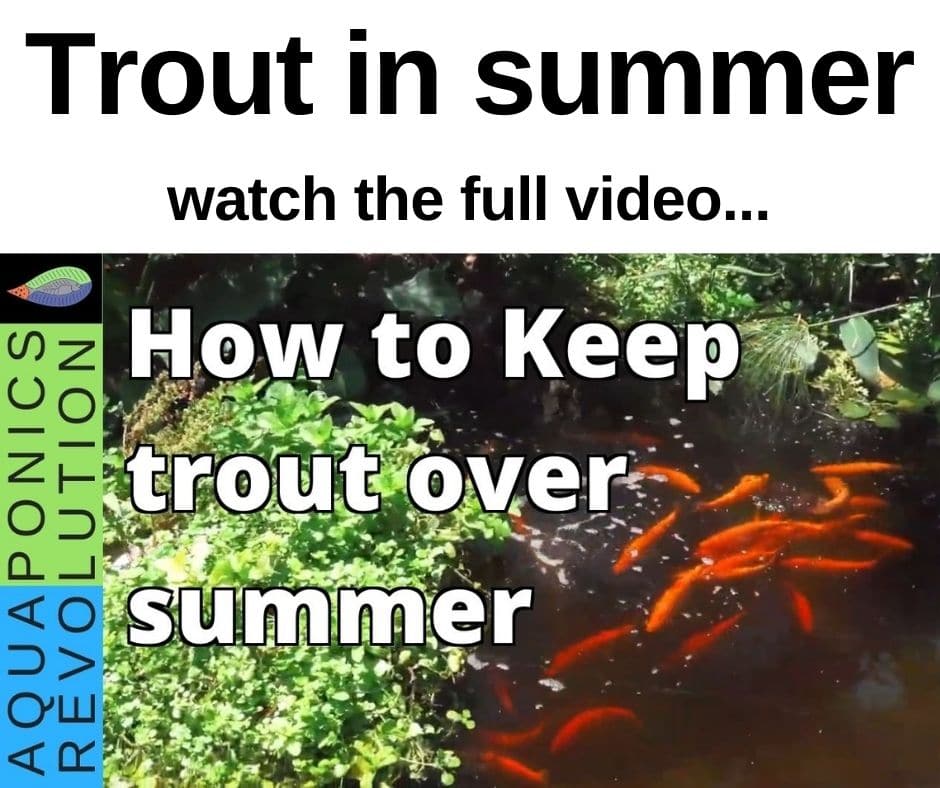
Trout are spectacular aquaponics fish — fast-growing, delicious, and perfect for cool climates — but summer heat is their biggest threat, and without a cooling strategy your fish will die.
Trout require water temperatures between 12°C and 18°C to thrive. Once temperatures climb above 20°C, their immune system weakens, oxygen absorption declines, and feed consumption drops. Above 22–24°C, mortality risk becomes severe. If you live in a temperate or warm climate, surviving summer with trout demands planning. Here’s exactly what to do.
Why Do Trout Struggle in Hot Weather?
Unlike warm-water species such as tilapia or silver perch, trout are cold-water fish with narrow temperature tolerance. Hot water causes three compounding problems:
- Oxygen depletion: Warm water holds less dissolved oxygen. Trout need at least 7–8 mg/L DO — at 22°C, that becomes very hard to maintain without supplemental aeration.
- Metabolic stress: Higher temperatures force fish to burn energy just staying alive rather than growing, leading to weight loss even with regular feeding.
- Immune suppression: Heat-stressed trout are far more vulnerable to bacterial infections, gill disease, and parasites like ich.
What Temperature Range Do Trout Need in Aquaponics?
Here are the key temperature thresholds to know:
- Ideal growth range: 14–18°C
- Acceptable range: 12–20°C
- Stress threshold: 20–22°C — reduce feed, increase aeration
- Danger zone: 22–24°C — mortality risk, implement emergency cooling immediately
- Fatal: 24°C+ sustained — most trout will die within days
Monitor temperature daily with a reliable aquarium thermometer or an automated temperature controller with alerts.
How Can You Cool Your Aquaponics Water in Summer?
There’s no single fix — effective summer trout management usually combines several strategies simultaneously.
1. Shade Your Fish Tank
Direct sunlight is the fastest way to heat a tank. Cover your fish tank with:
- A solid roof or pergola overhead
- 50–75% shade cloth stretched over the tank
- Reflective material (such as light-coloured polycarbonate roofing) to reflect radiant heat
Even partial shade can reduce water temperature by 2–4°C — often enough to stay below critical thresholds on moderately warm days.
2. Insulate Your Tank
Foam insulation panels or reflective insulation wrap around the outside of your tank dramatically slow heat transfer. This is particularly effective for tanks partially buried in the ground, where soil acts as a natural heat sink. Aim to insulate all sides that receive sun exposure.
3. Use a Chiller or Heat Exchanger
An aquarium chiller is the most reliable solution for serious trout growers. A chiller circulates tank water through a refrigeration unit, maintaining a set temperature automatically. Options include:
- Inline aquarium chillers (150–500 W): suitable for tanks up to 3,000 litres
- Heat exchangers connected to a domestic refrigeration system: cost-effective for larger systems
- DIY coil chillers using a chest freezer with stainless steel or food-grade coil: low-cost option for small systems
A chiller typically costs $500–$2,500 upfront but pays for itself in healthy, fast-growing fish.
4. Add Water Evaporation and Airflow
Evaporative cooling can lower surface temperatures by 2–5°C in low-humidity climates:
- Run a fan across the water surface — evaporation cools the water
- Add a fine misting system above the tank
- Ensure good airflow around your grow-beds and sump tank
Note: evaporative cooling is less effective in humid climates (above 70% relative humidity). Check your local summer humidity before relying on this method.
5. Top Up With Cold Water
During heatwaves, adding cold mains water (often 15–18°C) can temporarily cool your system. This needs to be done carefully — rapid temperature swings above 2°C per hour stress fish. Add cold water slowly through a hose at a low flow rate, and only as a short-term measure.
6. Increase Aeration
Even if you can’t lower temperature significantly, maximising dissolved oxygen buys your fish more time. During heat events:
- Add a second air pump or larger air stones
- Run a venturi aerator inline on your return pipe
- Keep water splashing vigorously into the fish tank (falling water picks up oxygen)
Target 7 mg/L dissolved oxygen minimum — test with a dissolved oxygen meter, especially overnight when plant photosynthesis stops.
Should You Reduce Feeding in Hot Weather?
Yes. When water temperature exceeds 20°C, reduce feeding to 50–60% of the normal rate. At 22°C+, stop feeding entirely. Uneaten food and digestive waste both increase ammonia load, worsening already-stressed water quality. Trout also lose appetite in heat — attempting to force-feed stressed fish is counterproductive.
Can You Switch Fish Species for Summer?
If your climate makes summer trout management impractical, consider switching to a warm-water species for summer months:
- Silver perch: ideal for Australian conditions, tolerates 10–28°C
- Barramundi: thrives above 26°C — perfect for tropical and subtropical regions
- Murray cod: handles a wide temperature range (12–26°C)
Many experienced aquaponics growers run trout in winter and switch to a warm-water species over summer. This “seasonal rotation” strategy maximises system productivity year-round without fighting temperature extremes.
Long-Term Planning: Design for Summer from the Start
The easiest way to manage summer temperatures is to design for it before you build:
- Position your fish tank in a north-facing shaded location (Southern Hemisphere)
- Build or purchase a tank with a lid or roof included
- Install a thermostat and alert system so you get notified if temperature rises
- Choose underground or partially buried tanks for natural insulation
- Budget for a chiller if you’re serious about year-round trout production
Frequently Asked Questions
At what temperature do trout die in aquaponics?
Sustained temperatures above 22–24°C are typically fatal for most trout species, particularly rainbow trout. Some hardier varieties (like brown trout) can tolerate up to 26°C briefly, but any prolonged exposure above 24°C will cause mass mortality.
How do I cool my aquaponics water cheaply?
The most cost-effective options are shading, tank insulation, and a fan-driven evaporative cooling setup. Together these can drop temperatures 4–6°C without buying a chiller. For serious summer production, however, a chiller is the reliable long-term investment.
How much does an aquaponics chiller cost in Australia?
Expect to pay $600–$1,800 AUD for a quality inline aquarium chiller suitable for home aquaponics. Larger commercial-grade heat exchangers can cost $3,000+, but DIY options using chest freezers can be built for $300–$500.
Can trout and warm-water fish share the same tank?
No. Their temperature requirements are incompatible. Trout need 12–18°C while species like tilapia and barramundi need 24–30°C. They should always be kept in separate systems.
Do aquaponics plants help cool the water?
Indirectly, yes. Dense plant canopies over raft (DWC) beds shade the water beneath and reduce solar radiation reaching the tank. However, this alone is not sufficient to cool your fish tank in summer — it’s a supplement, not a solution.
Want to build an aquaponics system perfectly designed for your climate from day one? Join our complete aquaponics training — including expert guidance on fish selection, seasonal management, and system design.