
If you have read anything about pH in aquaponics, you have probably been told that your bacteria need water around pH 7, and that below 6 the nitrogen cycle stops. Until today, this very article said the same. The research of the last ten years says the picture is more interesting, and a lot more forgiving.
This post is about the bacteria side of pH: who these bacteria are, what they actually need, what happens when the water gets more acidic, and what that means for a backyard system. I also walk through the 2024 study behind it in the video below.
What the bacteria in your system actually do
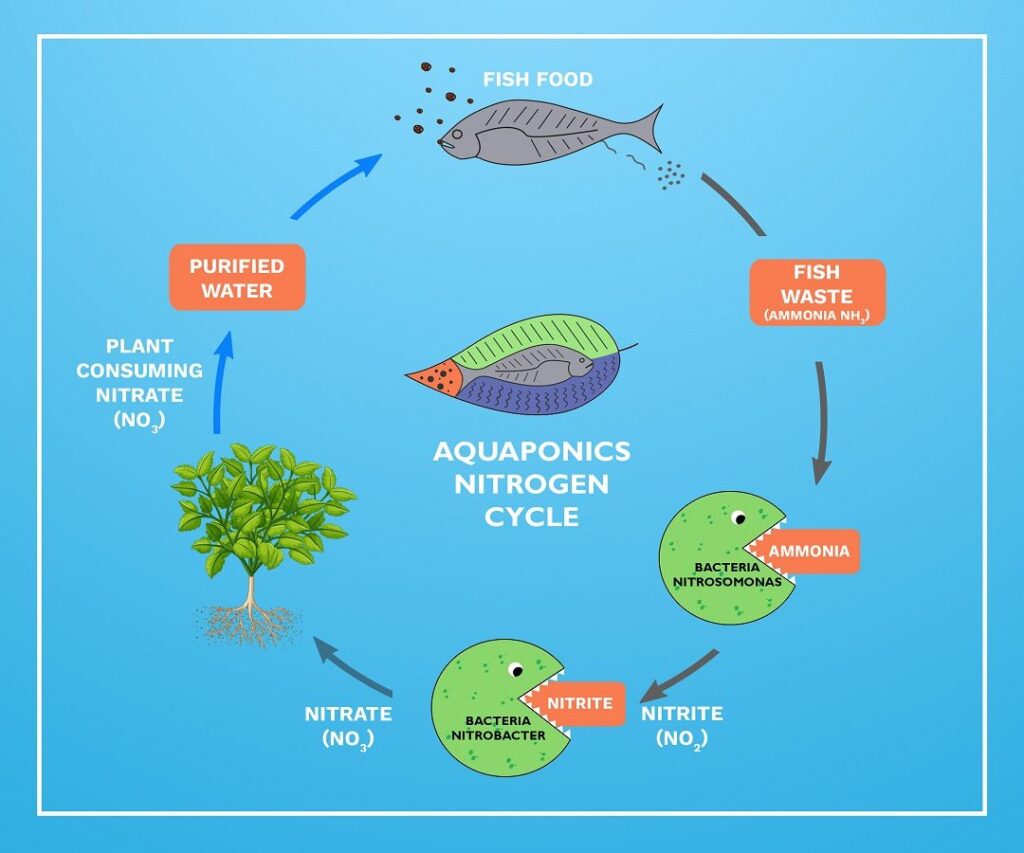
Your fish excrete ammonia. Ammonia is toxic, and so is nitrite, the next step. The bacteria living on every surface of your system, in the gravel, the media bed, the biofilter, the pipes, turn ammonia into nitrite and then nitrite into nitrate. Nitrate is safe for the fish and it is the main form of nitrogen your plants feed on.
Ammonia, nitrite, nitrate. That is the nitrogen cycle, and it is the reason an aquaponics system works at all.
For about a century, microbiology textbooks said this job needed two separate teams. One group of bacteria (the ammonia oxidisers, such as Nitrosomonas) did the first step. A second group (the nitrite oxidisers) did the second step. Both groups were understood to prefer slightly alkaline water, around pH 7.5 to 8.
Where the “keep it at pH 7” rule comes from
Plants, on the other hand, take up nutrients most easily in slightly acidic water, roughly 5.5 to 6.5. Put the two together and you get the classic advice: meet in the middle at pH 7. Not ideal for the plants, not ideal for the bacteria, but acceptable for everyone.
From there it was a short step to the warnings you still see everywhere: below 6.5 the bacteria slow down, below 6 they stop, and the nitrogen cycle collapses. That is the part I no longer agree with. It describes one group of bacteria. It does not describe the living community in a real system.
Comammox: the bacteria nobody counted on
In 2015, two research teams, publishing separately in Nature, described a bacterium that does both steps on its own, from ammonia all the way to nitrate, inside a single cell. They called it comammox, for “complete ammonia oxidation”.
Comammox bacteria live exactly where we need them: biofilters, soils, sediments, and the gravel and media beds of aquaponics systems. They tend to do well in slower, lower-ammonia environments, which describes most backyard systems that are not overstocked. And they cope with acidic water better than the classic two-team nitrifiers.
That changes the question. It is no longer “at what pH do my bacteria die?” It is “which bacteria will be doing the job at the pH my system settles at?”
What happened when researchers ran aquaponics at pH 6
A group at the University of Alberta tested this directly (Derikvand et al., 2024, iScience). They ran aquaponics systems growing lettuce with goldfish, some held at pH 7.6 to 7.8 and others at pH 5.8 to 6.0, well below what most manuals allow.
- The bacteria: at the lower pH the classic nitrifiers were suppressed, and comammox took their place. Nitrite was removed effectively in both systems, and there was no ammonia build-up or nitrite spike at low pH. The community changed. The job still got done.
- The lettuce: grew more at the lower pH in every round of the experiment. The difference was not statistically significant overall, but the trend was consistent.
- The fish: fine in both systems, with no mortality.
An earlier paper from the same group (Derikvand et al., 2021) had already shown that their bacterial community kept about 81% of its nitrification activity at acidic pH, with no measurable nitrous oxide, a greenhouse gas that conventional nitrifiers tend to release.
So “the nitrogen cycle collapses below pH 6” is not what this research found. What it found is that a diverse bacterial community reorganises itself and keeps working.
What this means for the bacteria in your system
1. A stable pH matters more than a perfect number
If your system sits at 6.5 or 6.3, your ammonia and nitrite stay close to zero, and your fish and plants look healthy, your bacteria are doing their job. You do not need to push the water back up to 7. The number to watch is not pH on its own. It is ammonia and nitrite. If those stay low, your nitrifiers are fine, whoever they are.
2. Change slowly, or not at all
Bacterial communities reshuffle over weeks, not hours. A sudden swing, from 7.5 to 6 in a day, stresses the fish and gives the bacteria no time to adapt, even if 6 would be fine in the long run. If your pH drifts down gradually because nitrification produces acidity, that is normal. Let the system follow it.
3. Do not chase pH 7 with chemicals
pH-down, pH-up and buffers all work for a while, then the water bounces back, often with a bigger swing than before. Every swing is a disturbance for the bacteria. If something keeps pushing your pH around, look at the cause instead: your water source, your substrate, how much you feed. A stable pH 6.5 is almost always better than an oscillating pH 7.
4. Give the bacteria a home, and time
Bacteria live on surfaces. A system with plenty of gravel or media, a mature biofilm and a moderate stocking density gives them room to settle and diversify. That diversity is your insurance: when one group is suppressed, another steps in. This is also why I prefer passive, low-energy systems that are allowed to mature, over systems run tightly by numbers. An aquaponics system is not a machine you control. It is a living ecosystem.
The honest limits
This is one controlled study, with goldfish and lettuce, over weeks rather than seasons. It does not say “run your system at pH 6”. It says the old compromise is more flexible than we were told, and that the bacteria are more adaptable than the old warnings suggest.
If you are starting a new system, start around 7 like most people do, cycle it properly, stock gradually and feed sensibly. Once it is stable and alive, let it settle where it wants to settle, and keep an eye on ammonia and nitrite rather than on the pH number alone.
Watch the video
I go through the study, the comammox bacteria and these takeaways in the first episode of Study of the Week:
If you are still getting the basics in place
The Art of Aquaponics is my 155-page illustrated manual: the nitrogen cycle, cycling a new system, which water parameters to test and how often, and the common mistakes behind most water problems. It comes with a 67-minute video of a classic system being built step by step. $27, instant access.
Sources
- Derikvand, P., Sauter, B., Keddie, N., & Stein, L.Y. (2024). Inoculum and pH effects on ammonium removal and microbial community dynamics in aquaponics systems. iScience, 27(3), 109073. https://doi.org/10.1016/j.isci.2024.109073
- Derikvand, P., Sauter, B., & Stein, L.Y. (2021). Development of an aquaponics microbial inoculum for efficient nitrification at acidic pH. Applied Microbiology and Biotechnology, 105, 5905-5917.
- Daims, H. et al. (2015). Complete nitrification by Nitrospira bacteria. Nature, 528, 504-509. https://www.nature.com/articles/nature15733
- van Kessel, M.A.H.J. et al. (2015). Complete nitrification by a single microorganism. Nature, 528, 555-559. https://www.nature.com/articles/nature16459
Talk soon,
Jonathan